


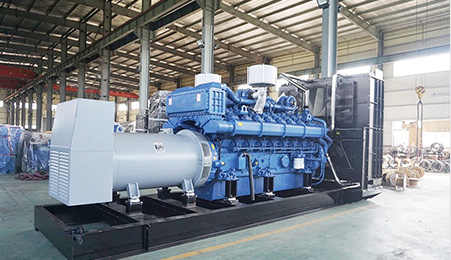
A Yuchai generator set is a diesel-powered generating unit built around an engine manufactured by Guangxi Yuchai Machinery Co., Ltd. (YC), one of China's largest and most established internal combustion engine producers. Understanding what a Yuchai generator set is starts with recognizing the company behind the engine: Yuchai was founded in 1951 in Yulin, Guangxi, and has since grown into a publicly listed enterprise with cumulative engine production exceeding 10 million units across automotive, construction, marine, and power generation applications. When the engine is paired with a matched alternator, control panel, and base frame — all integrated on a single skid — the result is what the industry refers to as a generator set, or genset. Yuchai generator sets occupy the mid-to-heavy power range and are deployed worldwide in standby, prime, and continuous-duty roles across infrastructure, manufacturing, data centers, and oil and gas facilities.
Yuchai's power generation line is distinct from its automotive division. The engines used in generator sets are purpose-built or adapted for stationary operation, with design priorities that differ meaningfully from vehicle engines: lower governed speed (typically 1500 RPM for 50 Hz markets), extended service intervals, and thermal management suited to prolonged full-load cycles. Authorized dealers and system integrators — rather than general trading companies — are the standard channel for sourcing genuine Yuchai gensets, because correct engine-alternator matching, emissions compliance documentation, and factory warranty coverage all depend on a verified supply chain.
Yuchai generator sets are available across a wide power band, from approximately 20 kVA at the low end to beyond 2500 kVA for large multi-cylinder configurations. The most widely specified models fall in the 100 kVA to 1000 kVA range, where Yuchai's in-line and V-type engines — including the YC6A, YC6C, YC6MK, YC6TD, and YC12VT series — provide high torque output, strong transient load response, and favorable fuel consumption rates. Rated output is expressed at both prime power (continuous variable load) and standby power (maximum 10% overload for limited hours), and buyers should confirm which rating applies to their quoted specification.
Engine displacement, aspiration method, and tier certification are the three technical parameters that most directly affect performance and procurement suitability. Yuchai genset engines are available in naturally aspirated, turbocharged, and turbocharged-intercooled configurations. Higher aspiration levels raise power density and improve altitude and high-ambient performance, which matters for installations in tropical or elevated-terrain environments. On emissions, Yuchai offers configurations certified to China's GB standards as well as engines meeting EU Stage II/III equivalent thresholds, relevant for export projects subject to host-country environmental regulations. Output voltage options typically span 380V/400V at 50 Hz and 480V at 60 Hz, with three-phase four-wire as the standard configuration. Control systems range from basic AMF (Automatic Mains Failure) panels to advanced paralleling controllers compatible with building management systems and SCADA integration.
Yuchai generator sets carry a practical advantage that procurement teams in industrial and infrastructure projects consistently reference: parts availability and service network density. Because Yuchai engines power millions of commercial vehicles and construction machines across Southeast Asia, the Middle East, and Africa, the regional distribution of spare parts — injectors, turbochargers, cooling components, and major assemblies — is substantially broader than that of comparable gensets built on less common engine platforms. For a facility operator managing a 10-year asset lifecycle, that parts ecosystem directly reduces the risk of extended downtime due to component sourcing delays.
From a total cost of ownership perspective, Yuchai gensets are competitive without compromising on build quality. Fuel consumption at 75% load for a well-matched Yuchai unit is typically in the range of 195–215 g/kWh depending on the engine series, which is consistent with international benchmarks for mid-tier commercial diesels. The engines are designed for 20,000-hour major overhaul intervals under recommended maintenance conditions, a figure that aligns with the expected service life of the facilities they power. Procurement teams specifying backup power for hospitals, telecom infrastructure, or manufacturing plants routinely select Yuchai generator sets because the combination of proven reliability, accessible service support, and competitive capital cost fits the risk profile of critical infrastructure projects.
Yuchai's status as a publicly listed company with audited financials and a vertically integrated manufacturing base also carries weight in B2B procurement contexts where vendor due diligence is part of the process. Unlike many engine brands assembled from third-party components under a badge, Yuchai manufactures its core engine components — including cylinder blocks, heads, and crankshafts — in-house, which provides a degree of quality control traceability that procurement auditors and engineering consultants value when preparing technical submittals.
Selecting the correct Yuchai generator set requires working through three sequential decisions: load sizing, duty classification, and site condition adjustments. Load sizing is the most common source of errors in genset procurement. The common mistake is summing nameplate ratings of all connected equipment and specifying a genset to match that total. The correct approach accounts for demand factor (not all loads operate simultaneously), power factor (motor loads draw reactive power that reduces effective generator output), and starting kVA — the surge current drawn by motors and compressors at startup, which can be three to seven times running current and must not exceed the genset's transient load capability. Undersizing a genset to reduce capital cost typically results in voltage instability, nuisance trips, and shortened alternator winding life.
Duty classification determines which power rating to apply. Prime power ratings apply when the genset is the primary source of electricity — common in remote industrial sites or regions with unreliable grid supply. Standby ratings apply when the genset operates only during grid failures, typically for limited hours per year. A unit quoted at 500 kVA standby may be rated at only 450 kVA prime, so confirming the applicable rating against the actual operating profile is essential. Site condition derating must also be applied: ambient temperature above 25°C and altitude above 1000 meters both reduce engine output, and manufacturers publish correction factors that should be incorporated into the final model selection. An authorized Yuchai dealer will apply these factors as part of the technical proposal rather than leaving them to the buyer to calculate after the fact.
Verifying the authenticity of the engine and genset package is the most important pre-purchase step when sourcing Yuchai generator sets, particularly through international channels. Genuine Yuchai engines carry a unique engine serial number traceable through Yuchai's manufacturer database. Authorized dealers can provide a factory certificate of origin, test report issued at the manufacturing facility, and warranty documentation registered against the serial number. Counterfeit or rebranded engines — sometimes presented as Yuchai-equivalent units — lack this documentation trail and will not qualify for factory warranty support or authorized service.
Installation and commissioning requirements deserve equal attention. A Yuchai genset is a system, not just an engine: the performance and longevity of the unit depend on proper exhaust routing with correct back-pressure limits, adequate combustion and cooling airflow in the generator room, vibration-isolated mounting, and correctly sized fuel supply lines and day tanks. Acoustic enclosures, if specified, must be sized to avoid heat buildup that can trigger engine protection shutdowns. Commissioning by a qualified technician — including load bank testing at 100% rated load for a minimum of two hours — should be a contractual requirement before site handover, as it validates that the installation meets design intent and establishes a baseline for future maintenance comparisons.
Maintenance planning should be established at the point of purchase rather than deferred to after installation. Yuchai's recommended service schedule for generator set engines includes engine oil and filter changes at 250-hour intervals, coolant system inspection and inhibitor replenishment at 500 hours, and injector and valve clearance checks at 1000-hour intervals. Compliance with the schedule is typically a warranty condition, and maintenance records are required to support any warranty claims. Operators in regions with limited direct service presence should confirm parts stocking arrangements with their dealer at the time of purchase to avoid delays when scheduled maintenance falls due.
A Yuchai generator set combines one of China's most widely deployed diesel engine platforms with matched generating equipment to produce a power system suited to the demands of industrial, commercial, and infrastructure applications. The combination of a broad power range, accessible parts network, documented service intervals, and verifiable factory origin gives Yuchai generator sets a strong position in international B2B procurement. Buyers who invest time in accurate load analysis, correct duty-rating selection, and verified sourcing from authorized channels will find that a properly specified and installed Yuchai genset delivers reliable, cost-effective power over a service life that justifies the capital investment.
Browse server-rendered product categories, application solutions, project references and technical articles. These direct links help buyers and search crawlers reach useful pages without relying on JavaScript menus.
Compare equipment families before confirming output, duty, environment and accessories.
Start selection from critical loads, motor starting, operating hours and site derating.
Read project references, company updates and generator-set selection or maintenance articles.
Wanjin supports generator-set sales, configuration checks, quotation, installation coordination, repair and scheduled maintenance.

