


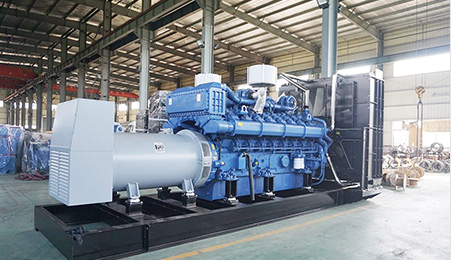
Yuchai diesel generator voltage and frequency options describe the electrical output configuration supplied by a generator set, including rated voltage, frequency, phase arrangement, and the allowable operating range. These parameters must match the site distribution system, connected equipment, and local grid standard. A Yuchai diesel generator set can be configured with different engine ratings, alternators, control systems, and output arrangements, but the available combination depends on the selected model and project requirements. For export and industrial applications, voltage and frequency should therefore be confirmed during technical quotation rather than assumed from the engine power rating alone.
A generator’s voltage is the electrical potential delivered by the alternator, while frequency indicates how many alternating-current cycles are produced per second. Frequency is measured in hertz, commonly written as Hz. The two principal frequency standards used in international projects are 50 Hz and 60 Hz. A 50 Hz generator normally operates at a different engine speed from a 60 Hz generator when the alternator has the same number of poles. For example, a four-pole alternator commonly operates at approximately 1,500 revolutions per minute for 50 Hz and approximately 1,800 revolutions per minute for 60 Hz.
Voltage may be specified as line-to-line voltage, line-to-neutral voltage, or both. In a typical three-phase, four-wire system, a designation such as 400/230 V means approximately 400 V between phases and approximately 230 V between any phase and neutral. Other commonly encountered project requirements include 380/220 V, 415/240 V, 480/277 V, and 208/120 V. These values are not interchangeable simply because they appear similar. The correct selection depends on the connected load, distribution equipment, local electrical practice, and the alternator’s rated output configuration.
Frequency and voltage should be treated as separate items in the technical data sheet. A project may require 400 V at 50 Hz, 480 V at 60 Hz, or another combination accepted by the local system. Phase arrangement is also important. Three-phase generator sets are widely used for industrial facilities, pumps, compressors, workshops, and commercial buildings. Single-phase output may be suitable for smaller or specialized loads, but it should not be selected for a predominantly three-phase installation without reviewing load balance and starting requirements.
The alternator, automatic voltage regulator, control panel, circuit breaker, cabling, and protection settings all have to support the selected output. The Yuchai engine supplies mechanical power, but the final electrical characteristics are determined by the complete generator set configuration. This is why the engine model and kW rating alone do not fully define voltage and frequency compatibility.
Incorrect voltage or frequency can prevent equipment from operating correctly and may create a safety or reliability risk. Motors are particularly sensitive to frequency because their synchronous speed is related to frequency. If a motor designed for 50 Hz is connected to a 60 Hz supply, its operating speed and performance may change. If equipment designed for 60 Hz is operated at 50 Hz, motor speed may fall and certain loads may draw excessive current or fail to provide the required output.
Voltage errors can be equally serious. Applying a substantially higher voltage than the equipment rating may damage insulation, power supplies, control components, or heating elements. Applying a lower voltage can cause motors to draw higher current while attempting to produce the required torque. This may result in overheating, nuisance breaker trips, poor starting, or unstable operation. The generator voltage must therefore be coordinated with the nameplate data of the largest and most critical loads.
Generator sizing is not based only on the continuous running load. Motors, transformers, fire pumps, refrigeration compressors, elevators, and some welding equipment can draw high inrush current during starting. This causes a temporary voltage dip. A generator that appears adequate when comparing only running kW may perform poorly when a large motor starts.
The selected Yuchai diesel generator set should be evaluated for running kW, starting kVA, motor-starting method, acceptable voltage dip, and the sequence in which loads will be connected. Soft starters, variable frequency drives, staged starting, and automatic load management can reduce starting demand, but they also introduce their own harmonics and control considerations. The alternator’s transient performance and voltage regulator response should be reviewed as part of the complete application.
For standby applications, the generator output must coordinate with the facility’s transfer switch, switchboard, protection devices, and emergency distribution circuits. If the generator is intended to operate in parallel with another generator or with the utility, additional requirements apply to synchronization, load sharing, reverse power protection, phase sequence, and frequency control.
In a prime-power or remote industrial application, the generator may become the main source rather than a temporary backup. In that case, voltage stability, frequency stability, fuel quality, ambient conditions, duty cycle, maintenance access, and load variation deserve particular attention. A correctly selected frequency and voltage configuration supports dependable operation, but it does not replace proper installation and commissioning.
The selection process should begin with the electrical characteristics of the site, not with a preferred generator model. Collect the utility or facility distribution voltage, frequency, number of phases, number of wires, grounding arrangement, and rated current. Confirm whether the installation requires a neutral conductor and whether line-to-neutral loads will be connected. The electrical drawings, equipment nameplates, and local project specifications should be used together because a facility may contain several voltage levels served by transformers.
Write the requirement in a complete form, such as three-phase, four-wire, 400/230 V, 50 Hz, or three-phase, three-wire, 480 V, 60 Hz. Avoid stating only “400 V generator” because the quotation may need to distinguish line-to-line voltage, line-to-neutral voltage, phase arrangement, and neutral configuration.
For export projects, the destination country is a useful reference but is not sufficient by itself. Industrial sites, mines, construction projects, data facilities, and vessels may use a system that differs from the common national practice. The actual project single-line diagram and load schedule should take priority over a general assumption about regional standards.
List continuous loads, intermittent loads, motors, heating loads, electronic equipment, lighting, battery chargers, pumps, compressors, and future expansion. Record each item’s voltage, phase, rated kW or kVA, power factor, starting current, and starting method where available. Separate essential loads from non-essential loads if the generator will supply only selected circuits during an outage.
Generator capacity is commonly discussed in kW and kVA. kW represents useful real power, while kVA represents apparent power and is influenced by power factor. The selected alternator must be suitable for both the real-power demand and the apparent-power demand. A generator with enough kW may still be unsuitable if the load has a low power factor, high harmonic content, or demanding motor-starting characteristics.
Ask for a project-specific technical quotation identifying the Yuchai engine model, generator-set standby or prime rating, alternator model, rated voltage, frequency, phase, power factor, control system, circuit breaker, and allowable voltage adjustment range. The quotation should also state whether the requested voltage is a standard alternator connection or requires a different winding or reconnection arrangement.
Some alternators can be connected for more than one voltage, while others have a fixed winding arrangement or limited reconnection capability. A selectable voltage option may also have limits on maximum output, neutral availability, or phase configuration. These details must be confirmed with the actual alternator data rather than inferred from a generic product description.
Ambient temperature, altitude, humidity, dust, ventilation, enclosure type, and exhaust routing can affect the generator set’s usable output. High altitude and high ambient temperature may require derating. If the generator is installed outdoors, the enclosure and cooling arrangement must be suitable for the site conditions. If it is installed indoors, the room must provide adequate combustion air, cooling-air discharge, exhaust extraction, fuel arrangements, and maintenance clearance.
Voltage and frequency selection should also consider cable length and voltage drop. Long cable runs between the generator and the main distribution board can create a significant drop during motor starting. Cable size, breaker rating, earthing, neutral treatment, and phase balance should be designed by qualified electrical professionals in accordance with the project’s applicable regulations.
The most common mistake is treating the voltage shown on a preliminary inquiry as the complete electrical specification. Before order confirmation, compare the quotation with the approved load schedule and single-line diagram. Verify rated voltage, frequency, phase, neutral, rated current, power factor, kW and kVA ratings, standby or prime duty, and the intended operating mode.
A clear quotation should identify the complete generator set rather than only the engine. It should state the Yuchai engine model, alternator manufacturer and model, control panel functions, automatic voltage regulator, output breaker, starting system, cooling system, fuel system, and applicable accessories. If an automatic transfer switch, synchronization panel, remote monitoring interface, sound attenuation enclosure, fuel tank, or installation service is required, each item should be listed separately with its technical scope.
For voltage and frequency, request written confirmation of the following points:
Rated line-to-line and line-to-neutral voltage; 50 Hz or 60 Hz frequency; single-phase or three-phase output; three-wire or four-wire arrangement; neutral availability and grounding method; rated power factor; voltage regulation; frequency regulation; allowable voltage adjustment; and any output derating associated with the selected configuration.
It is also important to distinguish factory testing from site commissioning. A generator may pass a factory test at its stated rating, but the installed system still needs inspection and functional testing. The commissioning plan should cover insulation and continuity checks, phase sequence, emergency stop operation, protective trips, battery charging, coolant and lubricant levels, fuel quality, exhaust conditions, transfer-switch operation, load acceptance, and measured voltage and frequency under appropriate load.
During commissioning, measure voltage between phases and between each phase and neutral where applicable. Confirm that the readings remain within the equipment and project limits during no-load, partial-load, and representative step-load conditions. Check frequency at the same time, because a stable voltage with an incorrect frequency is not an acceptable result.
Observe the generator during motor starting and load transfer. Record voltage dip, frequency response, recovery time, and any alarms. Check phase balance when single-phase loads are connected to a three-phase set. Unbalanced loading can increase neutral current, reduce efficiency, and create additional heating in the alternator.
After handover, maintenance records should include operating hours, load conditions, voltage, frequency, coolant temperature, oil pressure, battery condition, and alarm history. Periodic testing under an appropriate load is more informative than running the set briefly without load. Maintenance intervals should follow the approved engine and generator documentation, while the actual service schedule should also reflect fuel quality, dust exposure, ambient conditions, and duty cycle.
Do not select a generator solely by matching the total connected kW. Do not assume that a 50 Hz generator can be changed to 60 Hz without checking engine speed, alternator design, controller settings, output rating, and connected equipment. Do not assume that a nominal voltage listed in a request automatically includes the required neutral or phase arrangement.
Also avoid mixing components without confirming compatibility. The engine, alternator, controller, circuit breaker, transfer equipment, and protection settings must function as one system. When the project requires a nonstandard voltage, parallel operation, large motors, sensitive electronics, or frequent load changes, provide the full electrical information to the authorized Yuchai dealer at the quotation stage. Nanning Wanjin Mechanical & Electrical can use the project load data and site requirements to clarify the proposed generator-set configuration, installation scope, commissioning responsibilities, and after-sales maintenance support.
Choosing Yuchai diesel generator voltage and frequency options correctly means matching the generator set to the site’s complete electrical system. Confirm the actual voltage, frequency, phase arrangement, load profile, starting demand, installation environment, and operating duty before selecting the engine and alternator combination. A complete technical quotation and documented commissioning process help ensure that the generator delivers the required power safely and reliably for the intended industrial or export application.
Browse server-rendered product categories, application solutions, project references and technical articles. These direct links help buyers and search crawlers reach useful pages without relying on JavaScript menus.
Compare equipment families before confirming output, duty, environment and accessories.
Start selection from critical loads, motor starting, operating hours and site derating.
Read project references, company updates and generator-set selection or maintenance articles.
Wanjin supports generator-set sales, configuration checks, quotation, installation coordination, repair and scheduled maintenance.

