

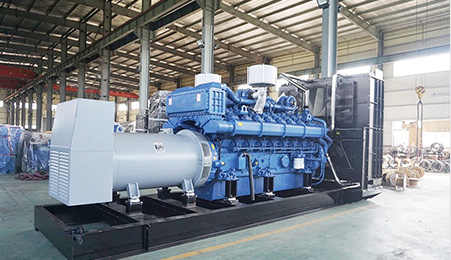
A Yuchai generator set for mining operations is a diesel-powered generating unit built on Yuchai engine technology, engineered to deliver continuous, stable electrical output under the harsh physical and environmental conditions characteristic of surface and underground mining sites. Mining operations — whether open-pit coal extraction, hard-rock mineral processing, or underground tunneling — depend entirely on uninterrupted power for ventilation systems, ore crushers, conveyor drives, dewatering pumps, and site lighting. A power failure in any of these systems is not simply an inconvenience; it represents immediate safety risk, production loss, and in underground settings, a potential life-safety emergency.
Unlike commercial or light industrial applications, mining power demands are defined by sustained high load cycles, extreme dust and particulate exposure, significant temperature variation between surface and subsurface environments, and geographic remoteness that makes rapid service response difficult. Generator sets deployed in these conditions must be specified, installed, and maintained with that operational reality as the baseline assumption, not an afterthought.
Standard commercial generator sets are typically rated for standby or prime power in relatively controlled environments. Mining sites operate at continuous or long-run prime ratings for extended periods — sometimes months without rotation — and the ambient conditions degrade engine performance, filtration systems, and cooling capacity far more aggressively than in factory or data center installations. Selecting a generator set that meets nominal nameplate ratings without accounting for derating factors, altitude correction, and thermal management under full continuous load leads to premature failures and costly unplanned downtime.
Beyond raw power output, mining operations require generator sets that integrate cleanly with site electrical infrastructure, including paralleling capability for load sharing across multiple units, automatic transfer switching for critical loads, and compatibility with motor-heavy equipment that generates significant inrush current on startup. These are engineering requirements, not procurement preferences, and they must be evaluated before equipment selection is finalized.
Guangxi Yuchai Machinery is one of China's largest and most established diesel engine manufacturers, with a production history spanning several decades and an export footprint across Southeast Asia, Africa, South America, and the Middle East — regions where mining activity is concentrated and where infrastructure challenges are routine. Yuchai generator sets for mining operations draw on this industrial heritage, offering engine platforms that have been refined through real-world deployment in demanding extraction and construction environments.
Yuchai's diesel engine lineup relevant to mining applications spans from mid-range units in the 100 kW to 400 kW range through to large-displacement engines capable of 800 kW and beyond. The core engine families used in generator set configurations — including the YC6MK, YC6C, and YC6TD series — are designed around high-torque, low-speed operating characteristics that favor generator set duty cycles over automotive performance profiles. This means stronger lubrication systems, heavier-duty crankshaft and bearing specifications, and cooling capacity sized for sustained thermal load rather than peak transient output.
For mining applications specifically, several technical attributes of Yuchai generator sets are operationally significant. First, Yuchai engines are designed to operate at altitudes up to 4,500 meters above sea level with appropriate configuration, which is relevant for high-altitude mining sites in regions such as the Andes, the Tibetan Plateau, or parts of Central Asia. Second, the engine control systems used in Yuchai generator sets support remote monitoring and fault diagnostic capabilities, which reduces dependence on on-site technical personnel for routine condition assessment. Third, Yuchai maintains a broad global parts distribution network, which addresses the supply chain vulnerability that remote mining operations routinely face with less widely distributed equipment brands.
Fuel flexibility is another practical consideration. Many mining sites, particularly in developing regions, do not have access to ultra-low sulfur diesel and may operate on higher-sulfur fuel stock. Yuchai generator set configurations can be specified with fuel systems and emission treatment approaches calibrated to local fuel quality, avoiding the performance degradation and injector damage that occurs when engines designed for Euro VI fuel standards are operated on lower-grade supply chains.
Sizing a Yuchai generator set for mining operations begins with a thorough load analysis, not with a catalog selection. The total connected load at a mining site includes both resistive loads — lighting, heating, control systems — and inductive motor loads from crushers, pumps, compressors, and ventilation fans. Inductive loads draw startup current three to seven times their running current, which means the generator set must be sized not for average running load but for the peak demand at the moment of sequential or simultaneous motor starts. Undersizing at this stage is the most common and most costly specification error in mining power projects.
Once the load profile is established, the next step is applying derating factors. Generator set nameplate ratings are published at standard conditions: sea level, 25 degrees Celsius ambient temperature, and clean combustion air. Mining sites frequently deviate from all three. For every 1,000 meters of altitude above sea level, diesel generator output decreases by approximately 3 to 4 percent due to reduced air density. High ambient temperatures — common in tropical or desert mining regions — further reduce engine output and increase cooling system demand. Dust-laden air increases filter restriction and reduces combustion efficiency. A properly specified Yuchai generator set for a mining operation at 2,500 meters altitude in a high-temperature environment may need to be rated 25 to 35 percent above the calculated base load requirement to deliver the required output reliably at site conditions.
The choice between a single large generator set and a paralleled multi-unit configuration is a strategic decision with maintenance and redundancy implications. A single large unit is simpler to install and operates at a lower cost per kilowatt when running at high load factor. However, a single unit offers no redundancy — any failure halts the entire powered system. Two or three smaller Yuchai units configured to parallel and share load provide operational flexibility: one unit can be taken offline for maintenance while the others continue to power critical loads, and total installed capacity can be matched more precisely to actual load by bringing units online incrementally. For large mining sites where ventilation and dewatering are safety-critical, paralleled redundancy is typically the appropriate architecture.
Enclosure and acoustic specification also require attention in the mining context. Open-frame generator sets are suitable where they can be housed in a dedicated power house that provides weather protection and controls airflow for combustion and cooling. Containerized or canopied units offer protection in environments where a dedicated building is not available or where the generator must be relocated as the mining face advances. Acoustic enclosures are relevant not primarily for community noise compliance at remote sites, but for reducing operator exposure to noise during maintenance activities, which has occupational health implications under most mining safety regulations.
Preventive maintenance intervals for Yuchai generator sets deployed in mining operations should be reviewed and typically shortened relative to standard service schedules. The particulate burden on air filtration systems in underground or dusty surface mining environments can reduce filter service life from the standard 250 to 500 hours down to 50 to 100 hours, depending on dust concentration. Operating with a restricted air filter causes fuel-rich combustion, elevated exhaust temperature, increased carbon deposits, and accelerated wear on piston rings and valve seats. Establishing site-specific maintenance intervals based on actual operating conditions — rather than adopting the standard schedule from the engine manual without adjustment — is a foundational requirement for maintaining generator reliability in mining service.
Coolant system management is particularly critical in environments with high thermal load. Yuchai generator sets use liquid-cooled engine configurations, and the coolant circuit must be maintained with correct antifreeze and corrosion inhibitor concentrations even in tropical climates where freezing is not a concern. Corrosion inhibitor depletion in coolant leads to cavitation erosion of cylinder liners, which is an expensive failure mode. Coolant quality should be tested at each scheduled service interval, and the full coolant circuit — including radiator core cleanliness and fan belt tension — should be inspected for condition at every maintenance visit.
Load bank testing is a practice that is frequently deferred in mining operations due to production schedule pressure, but it provides direct verification that the generator set can sustain full rated output under load — something that routine visual inspection and no-load running cannot confirm. For Yuchai generator sets on standby duty at mining sites, load bank testing at 75 to 100 percent of rated capacity for a minimum of two hours, conducted at least annually, is the standard practice to identify developing issues before they manifest as failures during an actual power event.
Fuel management deserves specific attention at remote mining sites. Diesel fuel stored in large tanks over extended periods is subject to microbial contamination, water accumulation, and oxidation degradation, all of which cause injector fouling and filter blockage. Fuel polishing — continuous filtration of stored fuel to remove particulates and water — is a cost-effective investment at sites where long-term bulk storage is necessary. Yuchai's common rail injection systems, used in higher-output generator set configurations, are particularly sensitive to fuel contamination, and protecting injector life through fuel quality management directly reduces operating cost.
Selecting and operating a Yuchai generator set for mining operations is an engineering process that begins with a detailed understanding of site conditions and load requirements and continues through commissioning, scheduled maintenance, and periodic performance verification. Yuchai's engine technology, parts availability, and operational track record in demanding industrial environments make their generator sets a technically credible choice for mining power applications across a wide range of site types and geographic contexts. The critical factor determining long-term reliability is not the equipment specification alone, but the rigor applied to sizing, installation, maintenance scheduling, and fuel quality management across the service life of the installation. Mining operations that treat their generator sets as engineered assets requiring systematic care consistently achieve lower cost per operating hour and fewer unplanned outages than those that treat power generation as a peripheral infrastructure concern.
Browse server-rendered product categories, application solutions, project references and technical articles. These direct links help buyers and search crawlers reach useful pages without relying on JavaScript menus.
Compare equipment families before confirming output, duty, environment and accessories.
Start selection from critical loads, motor starting, operating hours and site derating.
Read project references, company updates and generator-set selection or maintenance articles.
Wanjin supports generator-set sales, configuration checks, quotation, installation coordination, repair and scheduled maintenance.

