


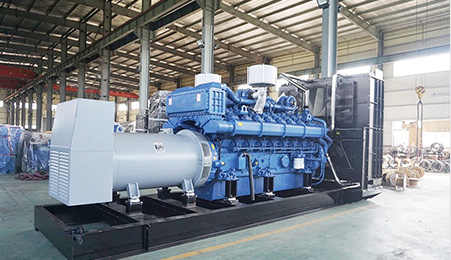
A Yuchai generator set is a diesel-powered generating unit built around an engine manufactured by Guangxi Yuchai Machinery Group, one of China's largest and most established internal combustion engine producers. For procurement engineers, plant managers, and project developers evaluating the best Yuchai generator set for heavy industry, the starting point is understanding what distinguishes this product line from generic alternatives. Yuchai engines are produced under strict ISO 9001 quality management systems, comply with relevant GB and international emissions standards, and are engineered for continuous or prime-power operation in demanding environments — from mining and cement production to large-scale construction sites and port logistics facilities.
Heavy industry places exceptional demands on backup and primary power equipment. Load profiles are rarely stable: motor-driven equipment creates high inrush currents at startup, arc furnaces and welding lines introduce harmonic distortion, and around-the-clock operation means a generator set must sustain rated output without thermal degradation over thousands of running hours. Yuchai's industrial-grade diesel engines — spanning displacement classes from under 3 liters to over 30 liters — are engineered with these realities in mind. Their broad power range, from approximately 20 kVA to well above 2000 kVA in a single-unit configuration, makes them a practical choice for facilities with highly variable power requirements.
Choosing the best Yuchai generator set for heavy industry starts with an accurate load analysis. Too many buyers size equipment based on connected nameplate load rather than actual running demand, which leads either to chronically underloaded sets that wet-stack and accumulate carbon, or to overloaded units that shorten engine life and void warranty coverage. A proper load study should capture peak demand, average demand, power factor, and any non-linear loads such as variable frequency drives or large rectifiers. Once those numbers are in hand, the general industry convention is to select a prime-rated generator set at roughly 80 percent of its rated capacity to allow headroom for transient surges.
Yuchai offers two primary rating designations relevant to heavy industry: Prime Power (PRP) and Continuous Power (COP). Prime Power sets are intended for applications where grid power is absent or unreliable and the generator carries the full site load for unlimited hours, with a 10 percent overload capability permitted for short durations. Continuous Power sets are rated for constant load with no overload allowance and suit applications such as isolated industrial parks or remote extraction sites with no grid connection at all. Standby-rated (ESP) sets, while part of the Yuchai lineup, are generally not appropriate for heavy industry as a primary supply source — they are sized and thermally designed for grid-backup duty cycles, not sustained full-load operation.
Engine model selection within the Yuchai range follows a logical progression. Mid-range industrial applications in the 200–500 kVA band are well served by the YC6B, YC6A, and YC6MJ series, which offer a balance of fuel efficiency and serviceability. High-demand applications above 500 kVA step up to the YC6T and YC6C turbocharged and after-cooled series, while installations requiring 1000 kVA and beyond typically utilize multi-cylinder configurations from the YC12VC or YC16VC families. Matching the engine series to the duty cycle — not just the peak kVA number — is critical for achieving the rated service life.
Beyond rated power output, several technical parameters determine whether a generator set will perform reliably under heavy industrial conditions. Voltage regulation is one of the most consequential: heavy industry loads with large motors or sensitive process control equipment typically require a voltage regulation tolerance of plus or minus one percent in steady state, achievable only with a high-quality brushless alternator and a digital automatic voltage regulator (AVR). Frequency stability is equally important — a governor system capable of plus or minus 0.25 Hz steady-state frequency deviation is the standard benchmark for process-sensitive applications. Yuchai sets paired with Stamford, Leroy-Somer, or equivalent alternators and equipped with electronic isochronous governors generally meet this threshold.
Transient response — the generator's ability to recover voltage and frequency after a sudden load step — deserves close attention. A set that dips below 15 percent of nominal voltage or takes more than three seconds to recover after a full-load application is poorly matched to motor-heavy facilities. Buyers should request official test data showing voltage dip and recovery time for the intended load step rather than relying on generic specification sheets. Fuel consumption data should similarly be requested at 25, 50, 75, and 100 percent load, not just at full load, because heavy industry facilities rarely operate at nameplate load continuously.
Cooling system design matters considerably in tropical and high-ambient climates where many heavy industry sites are located. Yuchai turbocharged industrial engines are available with both radiator-cooled and remote-radiator (heat exchanger) configurations. For enclosed engine rooms with limited airflow, a remote radiator or a water-cooled heat exchanger circuit is preferable to avoid recirculating hot exhaust air back into the combustion intake. Control panel specification is another frequently overlooked detail: heavy industry typically benefits from a DSE or ComAP deep-sea controller with parallel operation capability, load sharing logic, and remote SCADA connectivity, rather than a basic single-set controller.
The market for diesel generator sets in industrial segments is not free of counterfeit and misrepresented products. One of the most common problems buyers encounter is the sale of remanufactured or downgraded engines under a Yuchai badge without proper factory authorization. Genuine Yuchai industrial generator sets sourced through an authorized dealer — such as an official Guangxi Yuchai distributor — come with traceable engine serial numbers, factory warranty documentation, and verifiable type-test certificates. Buyers should always request the engine serial number prior to purchase and verify it through official Yuchai channels. If a supplier is reluctant to provide this information, that is a significant red flag.
Misrepresented power ratings are another well-documented issue. Some suppliers quote ISO 3046 standard conditions ratings while omitting deration factors for site altitude, ambient temperature, and fuel quality. A set rated at 500 kVA at sea level and 25 degrees Celsius may only deliver 440 kVA reliably at 1500 meters elevation and 40 degrees ambient — a 12 percent reduction that can critically affect process operations. Buyers should insist on site-derated power figures and, where possible, have an independent engineer review them before signing the purchase order.
Spare parts availability and after-sales support infrastructure are frequently underweighted in the purchase decision. A generator set is a long-lived capital asset; the total cost of ownership over a 15–20 year operating life far exceeds the initial acquisition cost. Buyers should confirm that injectors, turbocharger cartridges, water pump assemblies, and engine overhaul kits for the specific Yuchai engine model are stocked locally or can be sourced within an acceptable lead time. Suppliers who cannot provide a credible spare parts and service commitment should be evaluated accordingly. Service intervals for Yuchai industrial engines — typically every 250–500 hours for oil and filters, and every 2000 hours for more comprehensive inspections — should be factored into operational budgeting from day one.
Finally, parallel operation requirements are sometimes identified late in the project cycle. If a facility anticipates scaling capacity in future phases, selecting generator sets with parallel-operation-capable control systems and compatible alternator specifications from the outset avoids costly retrofits. Yuchai's larger industrial series support synchronized parallel operation natively when specified with appropriate control hardware, but this must be stated explicitly in the technical specification at the time of order — it cannot be assumed as a standard feature on all configurations.
Identifying the best Yuchai generator set for heavy industry requires moving well beyond nameplate kilowatts. Load profile analysis, accurate power rating selection, transient response verification, cooling system design, and a clear picture of after-sales support are all factors that determine whether a generator installation performs as expected over its service life. Yuchai's industrial engine range offers a credible solution across a wide power band, provided equipment is sourced through verified authorized channels and specified in detail against actual site conditions. For procurement teams and project engineers, a disciplined technical evaluation process — rather than price alone — is the most reliable path to a long-term, trouble-free installation.
延伸阅读:For Chinese product selection and local support, visitWanjin's Chinese service site.
Browse server-rendered product categories, application solutions, project references and technical articles. These direct links help buyers and search crawlers reach useful pages without relying on JavaScript menus.
Compare equipment families before confirming output, duty, environment and accessories.
Start selection from critical loads, motor starting, operating hours and site derating.
Read project references, company updates and generator-set selection or maintenance articles.
Wanjin supports generator-set sales, configuration checks, quotation, installation coordination, repair and scheduled maintenance.

